all the time
Xiaoxuan Huang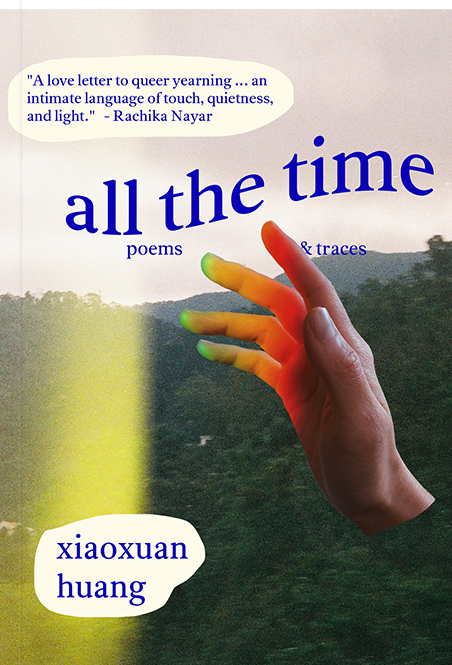
Poetry
Paperback
French flaps
144 pages
ISBN 9781988355764
Winter 2026
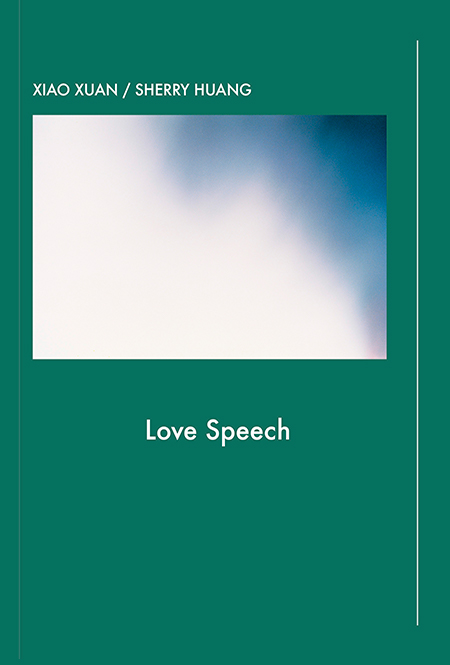
Bundle 1 includes all the time (Huang, 2026) & Love Speech (Huang, 2019)
Bundle 2 includes all Spring 2026 releases (all the time, Wavering Futures, Lateral Sway)
some ways of listening
turn the whole body
into an ear
In all the time: poems & traces, Xiaoxuan Huang crafts a profound exploration of queer longing, the fragility of language, and the spaces between speech and silence. Blending love letters, fragmented aphorisms, and poems where silence itself becomes a punctuation mark, this genre-defying collection asks: If words can never fully capture what we mean, do we still dare to speak?
Rooted in poetic rigor and philosophical inquiry, all the time insists on the urgency of address, even when words falter. It is poetry that thinks as deeply as it feels, inviting readers to linger in the liminal spaces between breath, memory, and meaning. For those who seek works that blur the lines between theory and heartache, this is a luminous testament to the necessity of speaking—even when the destination remains unknown.
Advance Praise
“Paradox and contradiction are such dramatic words when the truth of time is an infinite plane of total coexistence. Huang shows us how the voice of the ordinary – which, put simplest, is Love – is filled with quantum whispers. all the time is a cascading fantasia of the cut together-apart.”
—Fan Wu
“all my favourite poems dissolve / into essay,” writes Huang, embedding a thesis into the fabric of this intelligent and immersive long poem. Here the lyrical merges with the theoretical, yes, but also with the tentative, the repetitive, the durational continuity synonymous with existence. When the poet enacts full-body listening, everything holds the potential of poetry, even the gaps, especially the gaps. [The gaps visually perforate the page in parenthetical embrace and Huang offers a love poem to time.]”
—Klara du Plessis
“The first thing my partner ever typed to me over the internet was ‘every letter is a love letter‘—the same Chris Kraus quote that Xiaoxuan invokes here (among a kaleidoscope of other references). So many emails we sent in the following years through conflicts and transformation and long-distance longing, so many words rocketed into the ether that at their heart just said to one another, as Xiaoxuan writes, “all I want to hear is that you’re still there”
all the time writes a love letter of its own to these pieces of queer yearning by making an intimate language of touch, quietness, and light—the vocality of the three emerging from what reverberates within ‘the silence they share.’
And as the book goes on, this shared silence continues to multiply in some zero-sum quotient where ‘silence is divided by silence‘. Empty space not only surrounds the lines, but divides them—absence and distance held within the work’s recurring empty brackets much like ‘the way we hold our hands with nothing in them.’ In the speakers’ punctuated longing, beckoning, missing and caress of the anonymous addressee, we find the endless impossibility of fully accessing one another through language. The ‘unsendable letter‘ to the beloved on the other end of the line, the screen, the page…
But against the obstructions of language, Xiaoxuan leads us to the generative force of distance—all the time stands as heartening testament that these gaps, aporia, and very structures restricting us are equally ‘what made everything possible in the first place.’ When everything for which we pine is absent, here is a book that helps us take solace in the space between.”
—Rachika Nayar
Reviews and Media
Discorder Magazine
“all the time is a beautiful, searching poetry collection that turns longing, language, and time into a field of intimate discovery. Xiaoxuan Huang writes with rare precision and emotional intelligence, stretching silence and structure into something deeply felt.”
Montreal Review of Books – A review of all the time by Xiaoxuan Huang
Xiaoxuan Huang
Xiaoxuan Huang is a Shanghainese-Canadian writer, scholar, and educator whose work bridges poetry, critical theory, and queer autotheory. all the time is their second book, following their debut Love Speech (Metatron Press, 2019). The manuscript has been shortlisted for the Fonograf Editions Essay Collection Contest (2023) and the John Lent Poetry & Prose Award (2022). They teach English Literature and Creative Writing at Capilano University and reside in Vancouver on the unceded territories of the xʷməθkʷəy̓əm (Musqueam), Sḵwx̱wú7mesh (Squamish), and Səlílwətaʔ/Selilwitulh (Tsleil-Waututh) peoples.

This book was made possible with the support of the Canada Council for the Arts Literary Publishing Projects grant.